
Artifacts and Enigmas: Author interview
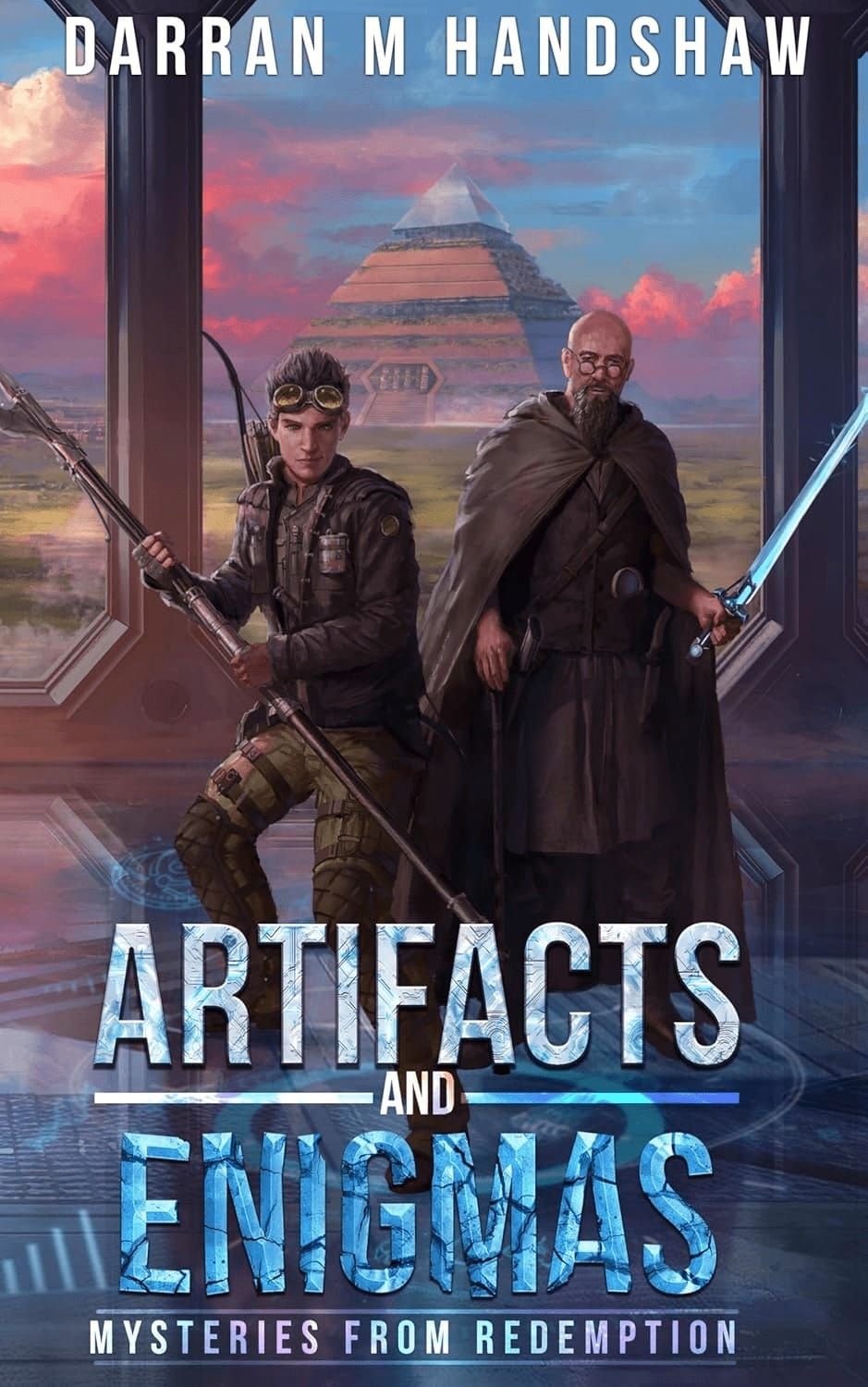
Artifacts and Enigmas: Mysteries from Redemption was one of my favourite speculative fiction reads of 2025. Here I interview Darran M. Handshaw about the inspiration behind this Sherlock Holmes-inspired collection of detective stories set in Pyramid, the ruined city of a fallen techno-civilisation.
One of the standouts of Artifacts and Enigmas is the budding friendship between prince-engineer Actaeon and knight-investigator Aethelgard. I know that Actaeon and his girlfriend Eisandre from your first novel, The Engineer, were based on the true story of how you met your wife through a text-based roleplaying game. Given that, I wondered where your inspiration for Aethelgard came from?
One of the reasons I ended up writing Artifacts and Enigmas is my boss, friend, and mentor, Ed Barkan, got me into reading Sherlock Holmes stories before he, unfortunately, passed away in October. He was a prolific inventor, a genius with 400 patents, who was always calm, collected and level-headed. He’d been my boss for ten years and I realised, after I finished Artifacts and Enigmas that there’s a lot of Ed in Aethelgard – the way he digs into details, for instance.
Given Aethelgard was inspired by Ed, how did he develop as a character, especially his friendship with Actaeon?
When I read the Sherlock Holmes stories, I didn’t like how much Watson acts as a lens. I preferred the stories where Holmes said, “get your gun ready, Watson, we’re going to need it.” Or, occasionally, where surgical knowledge formed a small part of the case since Watson is a surgeon. I wanted to replicate how Holmes and Watson played off each other when they both had an ability that could crack the case.
Another thing I wanted to copy was how Holmes and Watson grew closer and developed their friendship over the stories. When Aethelgard rushes in, in the first story, he’s not looking for a friend: he just needs an engineer. But, by the last story, they’ve become friends who try to figure things out together. They’ve even learned some of each other’s abilities – Aethelgard has learned some engineering and Actaeon has learned much about deduction.
You mention in the back of Artifacts and Enigmas that, as in Sherlock Holmes, the idea is to follow the characters as they figure out the crime, not to drop clues that would allow the reader to solve it. I wondered how you started about devising some of these mysteries, especially the intricate ones like [spoilers]?
That story was fun to write! I had read a lot about parasitism, such as toxoplasmosis, where you get scratched by a cat and it controls your mind a bit. Or cordyceps, a fungus that takes control of an ant and makes it walk to a specific location. I found it fascinating, and I imagined this weird beetle that needed to reproduce in a very hot environment, such as a volcanic tube, but found an artifact instead and started bringing people and animals down there.
And what about later in the book, what inspired you to write the other story about mind control?
That story is artifact-based, which is an interesting juxtaposition to the earlier one. My inspiration was that I wanted to screw up Aethelgard and take him out of the picture to make Actaeon solve the case himself. Aethelgard switches from working with Actaeon to fighting with him, which turns the story upside down. I was excited to write all about how that played out!
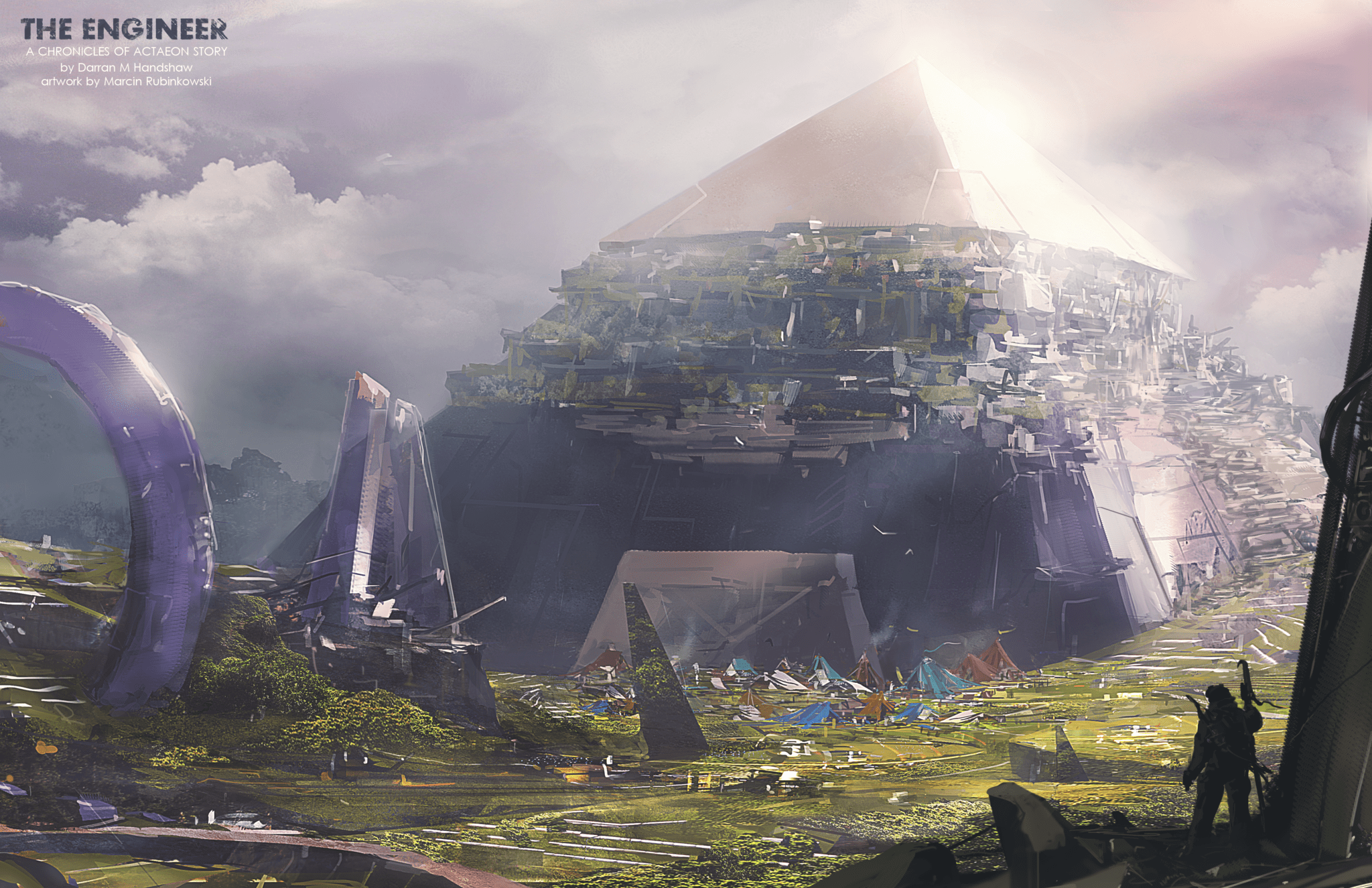
The post-apocalyptic setting of The Engineer books is remarkable in its originality. How did you come up with your ideas for the city of Pyramid, the technology and how it all works?
I can’t take complete credit. Much of the inspiration came from my wife Stefanie Handshaw and friend Simon Svensson, as Pyramid was the main area in our text-based RPG, Redemption.
A lot of that setting was inspired by Stargate Atlantis, a high-tech world left behind by the disappearance of its creators but, as a sci-fi author, I wanted to take that to another level. I fleshed many of the technologies in my stories, putting thought into what the Ancients had done with each of them. Actaeon gets to the bottom of some of the technology in my stories, but other times he thinks he’s right while I’m behind the scenes thinking “this is funny, he’s so wrong!”
As an engineer, that’s the truth of what happens in reality - often you look at a competitor’s product and think “ah, that’s why this is there” but, when you speak to the engineer who designed it, it was put in for a completely different reason.
This discovery and speculative process is so cool to highlight in the stories, but I like to have an idea of how the technology works. If you take the Light Lances from my novel Dark Heart of Redemption, for example, I did a lot of research into quantum physics to ensure that the technology is theoretically possible, rather than just going “this is a cool sci-fi weapon”. I’m not going to invent future technology, but I do like to know the theory behind it! I also like to know how weird, interesting technology like the Light Lances would affect the world around them. Lots of people, in sci-fi settings, have technology to fight a war but no one uses it in everyday life, as a cutting tool, for example, once the war is over!
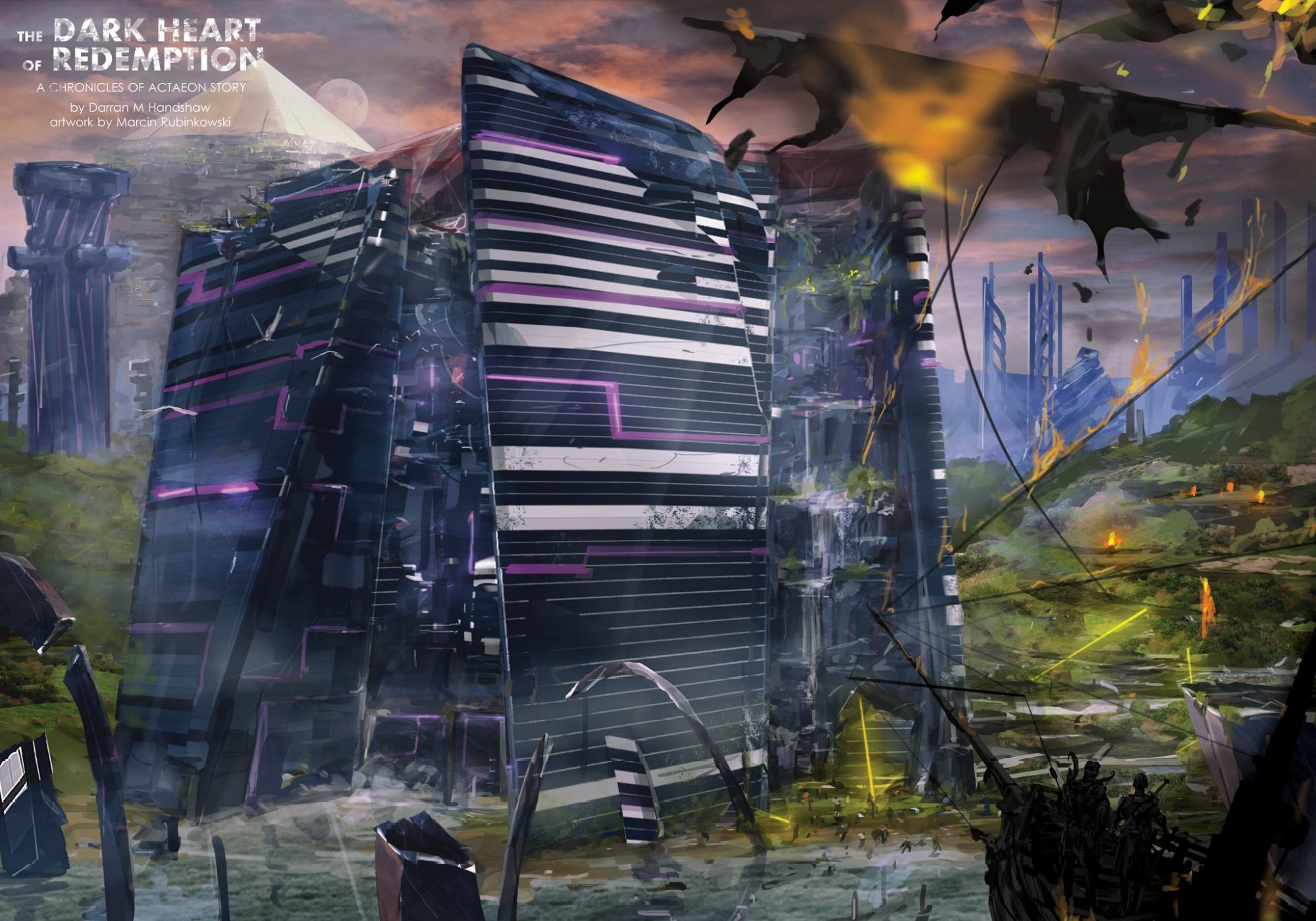
Where are you planning to take the series now? Will we see more adventures of Aethelgard and Actaeon? Or will you further develop your stories in the political direction we saw in Dark Heart of Redemption?
I really liked writing Dark Heart of Redemption, but it was very dark. I’d say it tread close to grimdark, but I found the end to be hopeful amid the dark moments. I don’t want to tread that far into darkness in a fictional world again.
Instead, I’m exploring some different concepts. I started writing a novel about what happened to Wave after Dark Heart and how he’s going to go beyond the city into another part of Redemption. I’m about three to four chapters in.
I usually only work on one project at a time but, when my boss died, I was devastated and, for my mental health, I needed to step back into the stories of Aethelgard and Actaeon. As such, I’ve just started a novella, as a follow-up to the short stories, and that’s also going to be a lot of fun to complete.
After that, I’ve got plans for two more books many years into the future of the Chronicles of Actaeon series and, also, a book of short stories, Tales of Redemption, which will tell stories about Wave, Trench, Eisandre, and few others in the Redemption universe. It’s also going to contain short stories about the Ancients and the Starborn to flesh out what happened to Redemption 5,000 to 6,000 years earlier and to tie that back to The Engineer. I was inspired to write Tales of Redemption by Tales from the Loop which is a TV show about crazy sci-fi concepts in a science research town with weird artifacts scattered everywhere. I still need to edit it and plan to release it in the next year or so.
I’ve come up with a nice way to wrap up the whole Redemption setting into a conclusion within maybe five or six novels and a few short story collections – it’s a very rich universe. My plan is everything ties in and each book is standalone, so you can start with any novel and still feel you’ve read a good story.
Either way, the sequel to Artifacts and Enigmas is the book I’m going to write next.
Thanks, Darran. I’m super-excited to hear all that.
I was sent an eArc of Artifacts and Enigmas and enjoyed it enough to schedule this interview. I previously reviewed Darran’s first book, The Engineer, here. The Engineer, Dark Heart of Redemption, and Artifacts and Enigmas are available to buy here.